
The Encino Oak Tree History
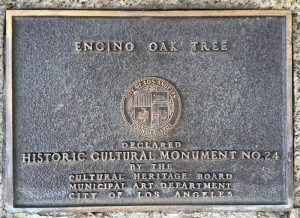
The Encino Oak Tree, which was called The Lang Oak also, was a 1,000-year-old Quercus agrifolia, or California live oak tree, located in Los Angeles, CA. It’s actually located just 5 minutes away from my Encino dental office. In 1963, the tree was designated to be a Los Angeles Historic-Culture Monument (HCM #24). Here’s where you can find it on the map:
At one point, the Los Angeles Times made note that the Encino oak had been a mere sapling when the Vikings were sacking sea towns in England and the Mayan Empire was starting to crumble. When the first Crusade was launched by Pope Urban II, the tree was 100 years old already. And in 1769 when the first Europeans came through Encino as part of their Portola Expedition, at that point the tree was over 700 years old.
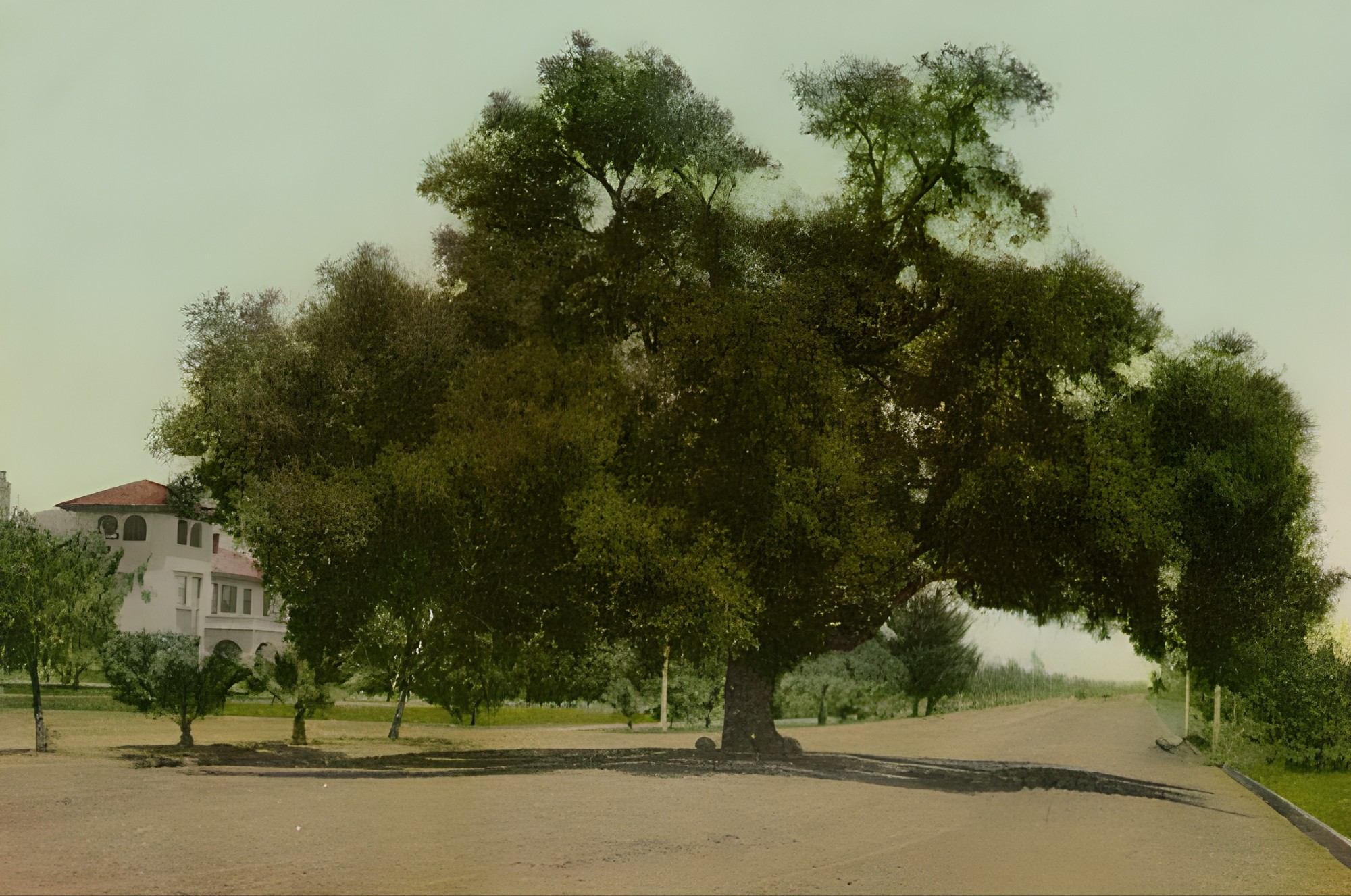
The Encino Oak Tree in the Mid 20th Century
During the mid-20th century, Encino developed into an established residential community. During this time the Encino oak became well known due to its longevity and size and was recognized as a famous landmark and known as the oldest tree in Los Angeles. When a California live oak tree is 300 years old that is when it’s considered to be old. The longevity of the Encino oak tree is considered to be extraordinary by arborists. One arborist compared it to standing near a dinosaur.
During pre-urban Encino times, the California live oaks were a very majestic and impressive presence. So much so, in fact, that they named the community for the Spanish word meaning “oak.” The most majestic of all of the oaks in the community was the Encino oak. It was so large that they had to split Louise Avenue in order to accommodate its gigantic 150-foot (46 meter) canopy, 24-foot (7.3 meter) circumference and 8-foot (2.4 meter) diameter. It was often said that the woodsy atmosphere created by Encino oak was more like an entire forest instead of just one tree.
The 1958 Bulldozing Threat to the Encino Oak Tree
The oak came under threat in 1958 when a developer made plans to have the tree bulldozed in order to build a road. A group was formed by local residents called Encino Save the Oaks. Eventually the developer ended up donating the tree to the city. In 1963 the tree was declared to be a Historic-Cultural Monument. The tree became a tourist attract in the years after it was designated to be a monument.
The 1990s Weakening of the Encino Oak Tree
The tree became in weakened condition during the 1990s. Some people blamed its condition on the Encino Reservoir, which was built in 1921, and cut the natural water flow off to the tree. Still others attributed it to all of the air pollution coming from all of the traffic on Venture Boulevard which was nearby. The tree had oak-root fungus also. Then in 1991, it got diagnosed as as having slime flux, which is a tree ailment where bacteria generates fermentation inside a tree and then toxic sap is sent to ooze through its bark. It was reported by arborists that the tree was in desperate need of some special care in order to save its life. City officials and arborists argued over what the right treatment was for the sick tree. One arborist suggested that small holes be chiseled into the bark so that the toxic sap that was killing the oak slowly could be released. Others argued that too much stress would be placed on the tree by the drilling, and that it should be left to heal on its own.
Efforts for saving the ailing oak turn into a highly publicized cause. The Los Angeles Times reported in 1996 that the oak was in trouble. It had mottled skin, that pins were used for holding some of its limbs together and its magnificent, shaggy head was hanging down from its great weight. In 1997, during an Arbor Day ceremony, the Encino oak was recognized and honored. In attendance was Wirt Stirling, who was the great-great grandson of J. Sterling Morton, the founder of National Arbor Day. He noted that he hadn’t ever seen anything nearly as phenomenal as the great oak.
The Final Days of the Encino Oak Tree
An El Nino storm, on February 7, 1998, dealt its death blow. The ailing tree was felled by strong storm winds. News of the tree’s death spread quickly, with crowds of people gathering to cry and take branches as souvenirs. After many decades of being threatened by pollution and development, it was noted by one resident that it was quite ironic that it was actually done in by nature. Police officers guarded the tree as so many souvenir-hunters tried to take away pieces of it so that the remains could be taken. One of the officers noted how things got out of control and how sad it was that two policemen had to be taken off of the streets in order to guard a tree.
Here is all that is left of this magnificent tree
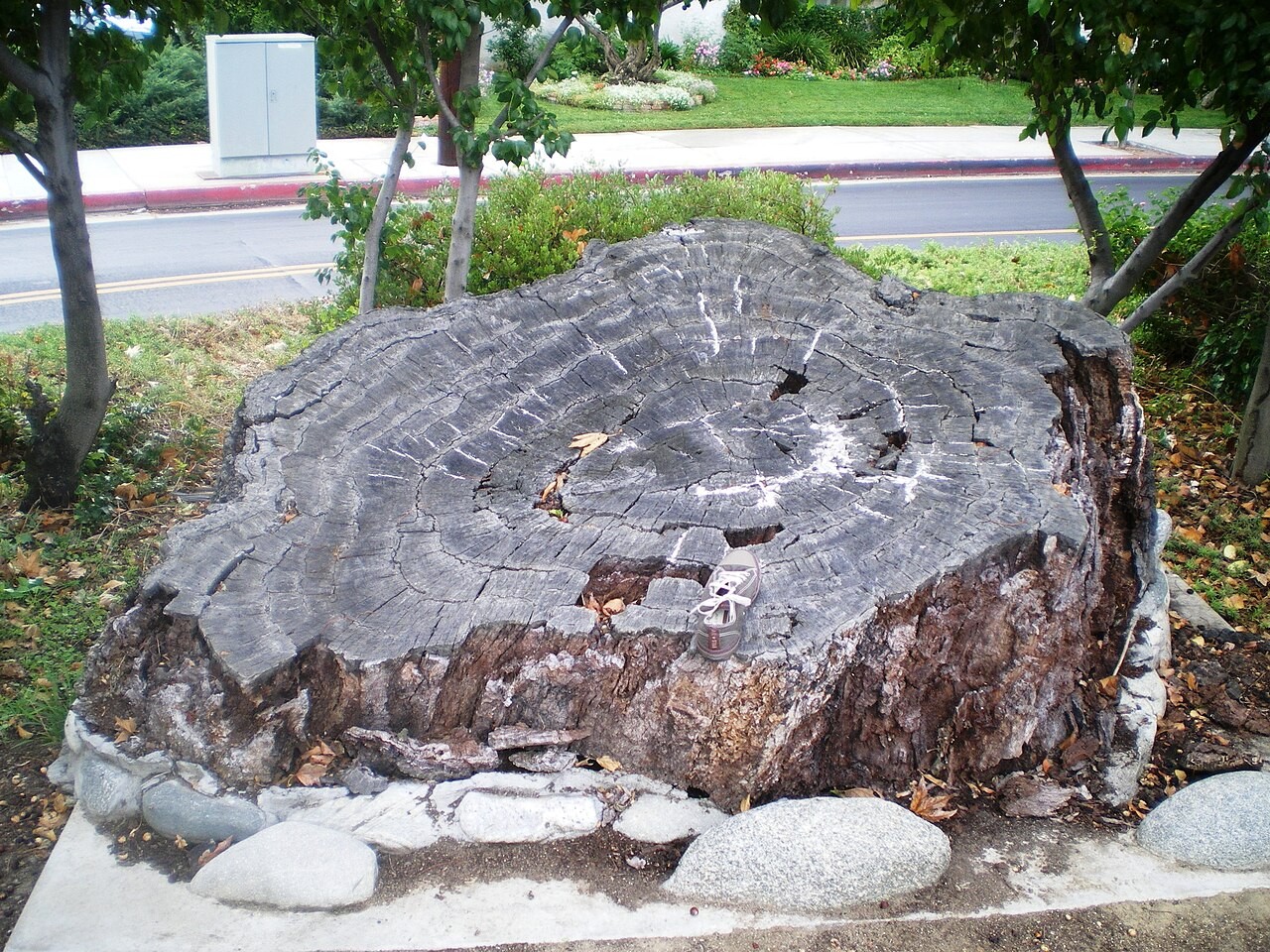
During the weeks that followed the death of the tree, city officials were debating what to do with its remains. This led the Times to wonder how many arborists, urban planners, homeowners, City Council aides and bureaucrats were needed to decree the mighty oak’s fate? The city ultimately decided to plant five new trees in the spot where the Encino oak once had been (right down the street from The Stand Encino Restaurant) – two coast live oaks and three California sycamores. During a ribbon-cutting ceremony in April 1999, an 8 x 6 foot oval section of the tree was unveiled by the city.
Pictures of the Encino Oak Tree
If you would like to see pictures of what the Great Encino Oak Tree (AKA The Lang Oak Tree) used to look like, here they are: https://www.wildbell.com/oak/index.htm
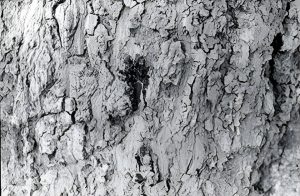
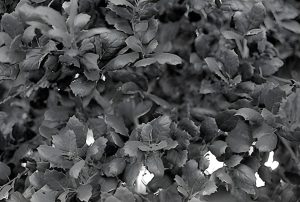
And just in case that site ever goes down, here’s the article posted there:
A Tall Tree’s Tale
By Will Campbell
Spring 1992
Wherever you are at this moment, chances are that on the precise spot where you’re reading these word , it can safely be said that on this date 1,000 years ago nothing much happened. There are those of us that feel the same can be said for the entire San Fernando Valley.
It is true that great revolutions were not spawned in what is now known to be Chatsworth. Little or no Civil War battle activity took place in the Sepulveda Basin. Woodland Hills holds no architectural ruins of ancient civilizations that boggle the mind in awe of their mass and construction. No, Warner Center does not count.
But contrary to popular account, the San Fernando Valley did not suddenly come into existence when developers moved in after World War II. It’s floor did not suddenly just blossom from nothingness into grids of single-family homes, swimming pools and street lights. There is a history here. Although not one as exciting as say, London’s, it extends back in time almost as far. And though by the year 963 we can find that the London Bridge was already in existence, around that same time, an oak tree began to grown in what is now Encino.
It is a magnificent oak tree. And unlike the bridge, the final version of which now resides in Arizona as a tourist attraction, the oak tree is in the same place it has always been. It is the storyteller of the Valley more than a million of us call home.
Just think, the Encino Oak was growing, perhaps just a sapling, when the Vikings were raiding England. It existed before the delivery of our present arithmetical notation by the Arabs to Europe. It predates the development of a musical notation system. In an abstract sense it is older than music and numbers.
This stately oak discovered America more than 500 years before Columbus.
But it’s just a tree, right? A living presence, agreed, but really, it does little more than provide birds a place to nest and wary travelers shade from the sun, right?
Visit this tree. Visit this California Live Oak, also known as the Lang Oak or the Encino Oak Tree, with its trunk 24-feet around, and a branch spread that forms a leafy canopy some 150-feet across.
Look up through its twining branches and dusty leaves to the light that filters down from a sun that has passed over and nourished this tree every one of its 380,000 days. It’s so much more than a tree. This oak is a sentinel of time. It is the embodiment of strength, perseverance and patience.
But look at the oak’s surroundings. Asphalt, street signs, cinderblock and smog. Crammed between a shopping center and a savings and loan on Louise Avenue just south of Ventura Boulevard, the tree is imprisoned in a small corner of the pave-every-inch world we have created. We have defined its world. With its trunk surrounded by a concrete median as automobiles slip back and forth, fouling its air, we have captured and caged it and ignored it like the last living example of an extinct species.
Look at its leaves. They are coated and sticky with grime and soot. Beneath it, there is no ground to walk on. Encircling it are wooden pallets that presumably protect the surface roots from damage and help prevent soil erosion.
Yet with all this encroachment, with its natural environment plastered and painted over, the oak still stands tall and proud, but not without its wounds. A study by renowned arborist Alex L. Shigo led him to state in a Los Angeles Times article that the tree’s illnesses were probably a result of damage caused by road construction projects. He determined that the oak’s trunk had been ailing for as long as 15 years, and recommended a 10-square-foot patch of bark be removed to aid in the healing process.
“Once the bark is removed, the wood inside should be cleansed of burrowing insects,” Shigo told the Times. It was, and the tree continues to survive with both the help and hindrance of man.
Now, the implication being made is not one of an uncaring community that would sacrifice the tree in the name of progress. After all, the Lang Oak was declared Historical Monument No. 24 on Sept. 6, 1963, by the Cultural Heritage Board of the Municipal Art Department of the city of Los Angeles. And Encino, which means “oak” in Spanish, is clearly a community that takes great pride in its historical asset. But could you picture a condominium complex going up next door to the San Fernando Mission, which was founded in 1797? Would the city approve a convenience store going up next to the Andres Pico Adobe, built in Mission Hills in 1834?
Both of these places are of great historical importance and have a well-deserved distance from commercialism and crowding brought on by poor city planning. If you don’t believe in the benefit of distance, just ask the Encino Oak’s younger cousin over in Canoga Park at Historical Monument No. 31: the Orcutt Ranch Horticultural Center. A mere 700 years old, this thriving Coastal Live Oak overlooks rose gardens, citrus and walnut groves, along with the many other varieties of trees, shrubs and flowers that occupy the center’s 26 acres. It’s too bad William Orcutt and his wife Mary didn’t own the land around the Encino Oak, because it’s a safe bet they would have understood the importance of protecting its natural environment.
It was that natural environment first observed and detailed on an August day in 1769, about seven years before the signing of the Declaration of Independence. Father Juan Crespi, traveling with an expedition led by Gaspar de Portola in an exploration north from San Diego to Monterey, had this to say about the valley they beheld as they crossed over the Sepulveda Pass through the Santa Monica Mountains.
“We saw a very pleasant and spacious valley,” he wrote. “We gave to this plain the name Valle de Santa Catalina de Bononia de los Encinos.”
Can you imagine seeing the San Fernando Valley as he saw it? Take away the millions of people, cars, house, businesses. Erase the roads, power lines, trash and everything else, and you’re left with the pristine solitude of “Valle de los Encinos.” It would be nice to imagine Crespi, Portola and the entire expedition, crested the rim of the Sepulveda Pass, dropped down to the valley floor, headed west along the Los Angeles River — the real thing, not the oversized drainage ditch we now possess — and after traveling for not more than a couple miles and encountering a few of the valley’s native inhabitants — the Tongva and Chumash Indian groups — soon discovered in front of them a stately oak tree that would provide them with the perfect place to set up camp for the next day’s examination of the area.
And after corralling the livestock and horses, with the expedition making camp, it would be nice to believe that Portola, observing the grand oak and choosing a spot beneath the leafy boughs for his tent, leaned against the tree’s sturdy trunk and appreciated the shade it provided against the hot afternoon sun.
Did it happen that way? Did the Portola expedition drift off to sleep later under the protection of the Encino Oak tree? Who knows? But if it did, it happened with the oak close to its 800th birthday. And yet, it happens now, with the oak approaching its 1,030th. Not with a brave explorer beneath the tree, but with a lonely, lost woman.
She would not give her name when asked, but she did confide that she loved to spend time with “her tree.” Homeless for years, she said she tries to pick up after the people who throw trash from their cars. She doesn’t like people that try to “hurt” the tree that way.
On a Sunday afternoon she was there, sitting across the street from the oak and watching it carefully. She said the tree was “very, very old” and pointed to plaques that had been placed in recognition of its historical status. She added that she’s not allowed to sit under the tree for very long. When the police come they tell her to move. But she loves to sleep under the tree when she can.
“It makes me feel safe,” she said.
And although she said she moves around quite a bit, she does not worry about the tree when she’s away from it. “I miss it, but I know it will be there when I come back,” she said.
A lot of people feel that way.
The Encino Oak has been a local anchor of stability in an ever-transforming city and world. When you look at, or touch the tree, you can see and feel the past, present and future at once. Frozen. As if the tree is a time-traveler that never moves. It is the then, the now and the what-will-be, rolled up into one awe-inspiring organism. It deserves respect, consideration and admiration. Above all, it needs our protection.
Without it the Encino Oak will be history.
— • —
Epilogue
Almost six years after this article’s publication in the Spring 1992 issue of the Piece College magazine The Bull, the Encino Oak found itself in the thick of a series of El Niño-powered storms that tore through Southern California. With its branches weighed down by punishing rains that also softened the soil around its trunk, the tree uprooted, fell and died the evening of February 7, 1998.
In a touch of irony that pointed to the fact that the 50-odd years of valley growth and development was a strong contributor to the tree’s death, I am proud to write that its limbs did crush two empty cars parked within reach of its 150-wide bough spread.
As the sound of chainsaws filled the air, many people who came to the scene of destruction over the somber days that followed openly wept as if losing an old friend. Some made dashes under the yellow police tape to get a branch here, a twig there… something with which to remember the 1,000-year-old landmark that was now history.
Heartsick, I myself took nothing more than a single, small leaf that I still have. It was enough.
A year later, near the first anniversary of the oak’s demise, another oak tree was planted, and a section of the 1,000-year-old oak’s trunk was placed near where the majestic tree had once stood so tall and proud. I’m not sure if the monument serves as testament to the oak’s grandeur, or our failure to protect it.
Directions From The Encino Tree To Dr. Linda Makuta DDS Encino Dental Care

Gianna Smart
Hello Dr. Makuta,
I just came upon this today, as I was getting nostatlgic for the old Encino oak I grew up with. I lived on Rancho, so we came in contact with that tree a lot. I loved it too, and was heartsick when it died. Thank you for putting together a historic perspective about it on your site. It means alot to the community of people who knew the tree, and who love all trees. Thank you.
Dr. Linda Makuta, DDS
Thank you so much for your kind words Gianna. It means a lot to me 🙂